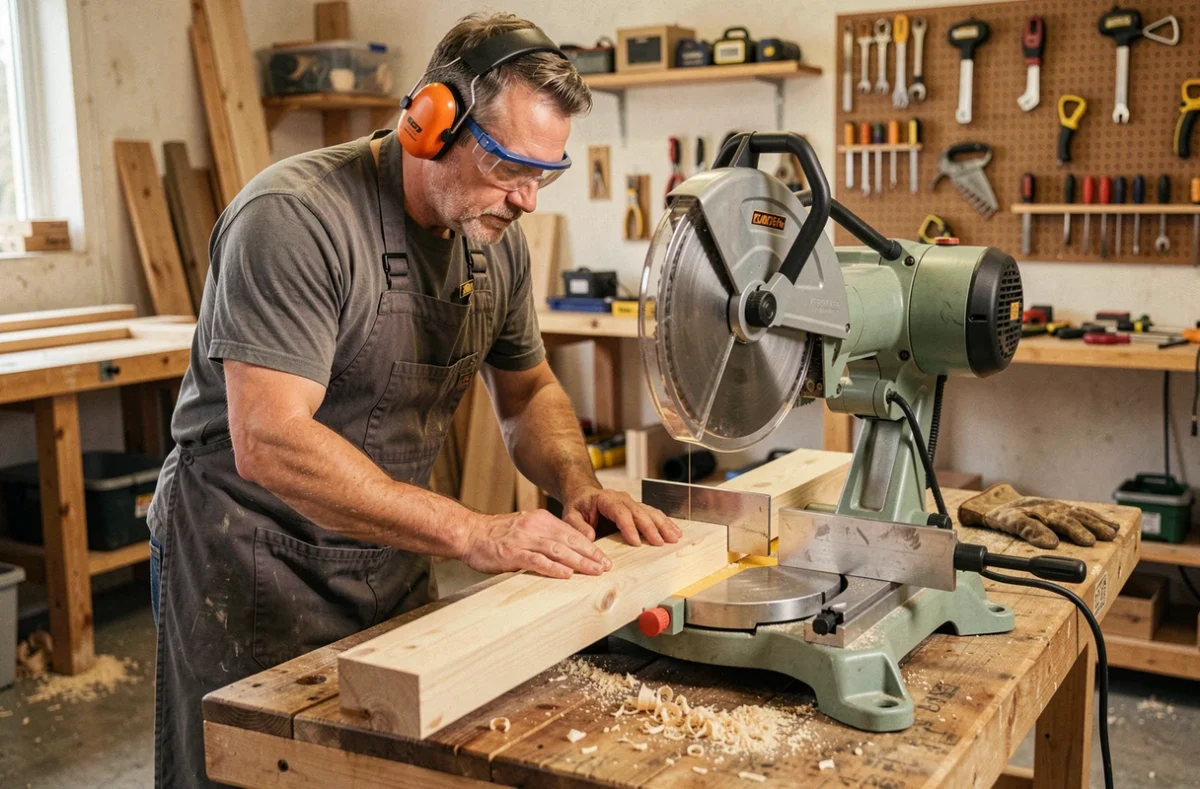
On a parquet or baseboard installation site, the radial miter saw saves a considerable amount of time. It allows for repeated angle cuts with a consistency that no manual saw can offer.
This consistency has a downside: the power and speed of the blade do not tolerate approximation. Mastering the radial miter saw means first understanding the points where the machine can put you in danger, and then integrating precise movements that become automatic.
Mobile guard and blade: the two checks that prevent most incidents
Before even plugging in the machine, check the mobile guard. This cover should move freely and automatically adjust to the thickness of the material. If it rubs, remains open, or does not return properly to the resting position, the saw should not be used. Neutralizing or blocking it is a dangerous practice that removes the barrier between the blade and your hands.
The second point concerns the blade itself. A warped, dirty, or dull blade poses more than just a finishing problem. It causes overheating of the material and puts more strain on the motor, increasing the risk of kickback or binding. Visually check the condition of the teeth, run a finger (machine unplugged) along the side to detect warping, and replace any questionable blade without hesitation.
To delve deeper into the use of a radial miter saw, these two checks are the minimal foundation before each work session.
Angle and bevel adjustments: field method for reliable cuts
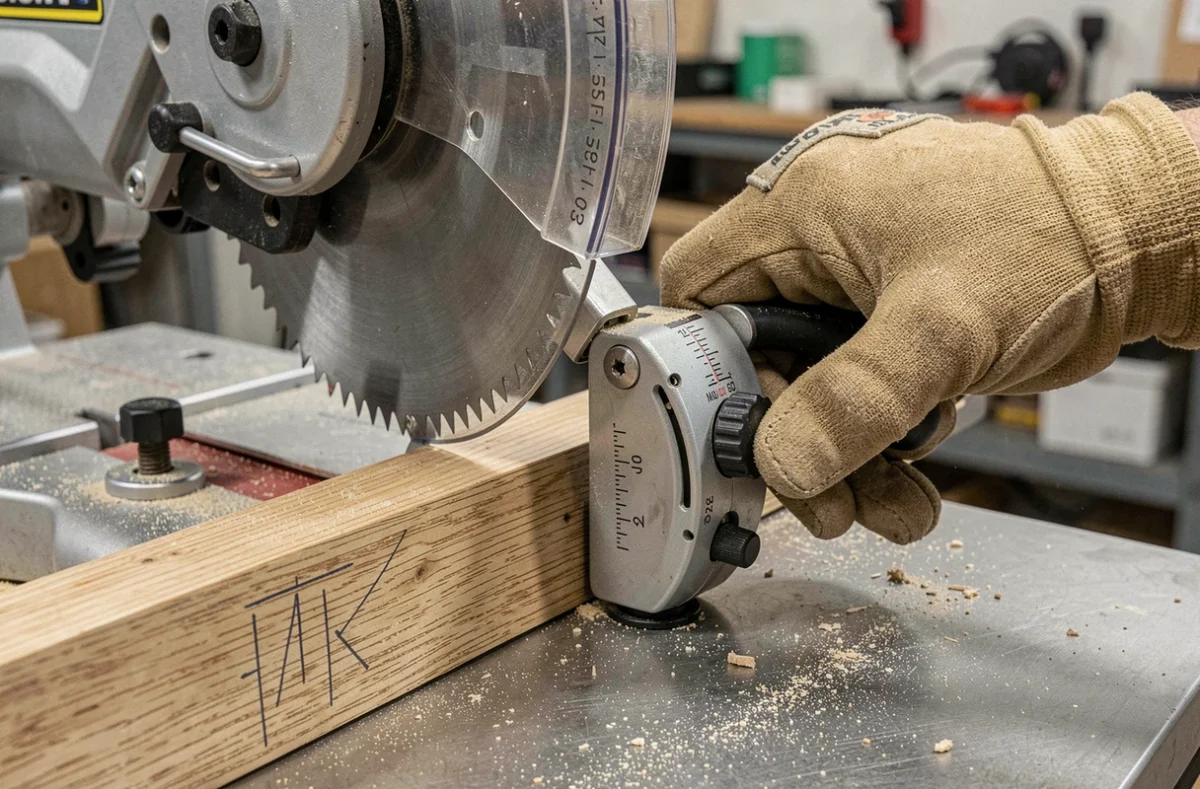
Often, poorly cut pieces occur because the operator relied on the markings on the table without verifying them. Factory markings can show slight misalignment after a few months of heavy use. The safest method is to set the angle to the desired marking, then make a test cut on a scrap piece.
Locking the pivoting table
The pivoting table allows for miter cuts. Once the angle is chosen, firmly tighten the locking mechanism. If the table moves during the blade’s descent, the cut will deviate, and the piece may be thrown. On some models, the lock can loosen with vibrations: it’s good practice to check it again between two series of cuts.
Tilting for bevel cuts
The cutting head tilts sideways for bevel cuts. This adjustment requires more attention: it changes the position of the mobile guard relative to the piece. After each change in tilt, check that the guard descends correctly and that the blade does not touch the table or the guide.
Always make a test cut on a scrap piece before tackling the final piece. This reflex takes a few seconds and prevents wasting material.
Holding the piece and body position: what happens during the cut
Most accidents occur during the cut when the piece is not held properly. Press the material against the rear guide and on the table, never holding it by hand near the blade. Clamps or the clamping device provided with the machine are there for that.
- Press the piece simultaneously against the vertical guide and against the table before starting the blade’s descent.
- Use a clamp or integrated press for short pieces (less than twenty centimeters), as fingers would be too close to the cutting area.
- Provide a lateral support (table extension or trestle) for long pieces to prevent them from tipping at the end of the cut.
- Never cross your arms above the blade’s path to catch a falling piece of material.
Body position is as important as clamping. Stand slightly offset from the blade’s axis, never directly in line. Wood chips and material fragments travel along the cutting axis, and safety glasses do not always compensate for poor positioning.
Safety register and machine tracking: an often-overlooked obligation
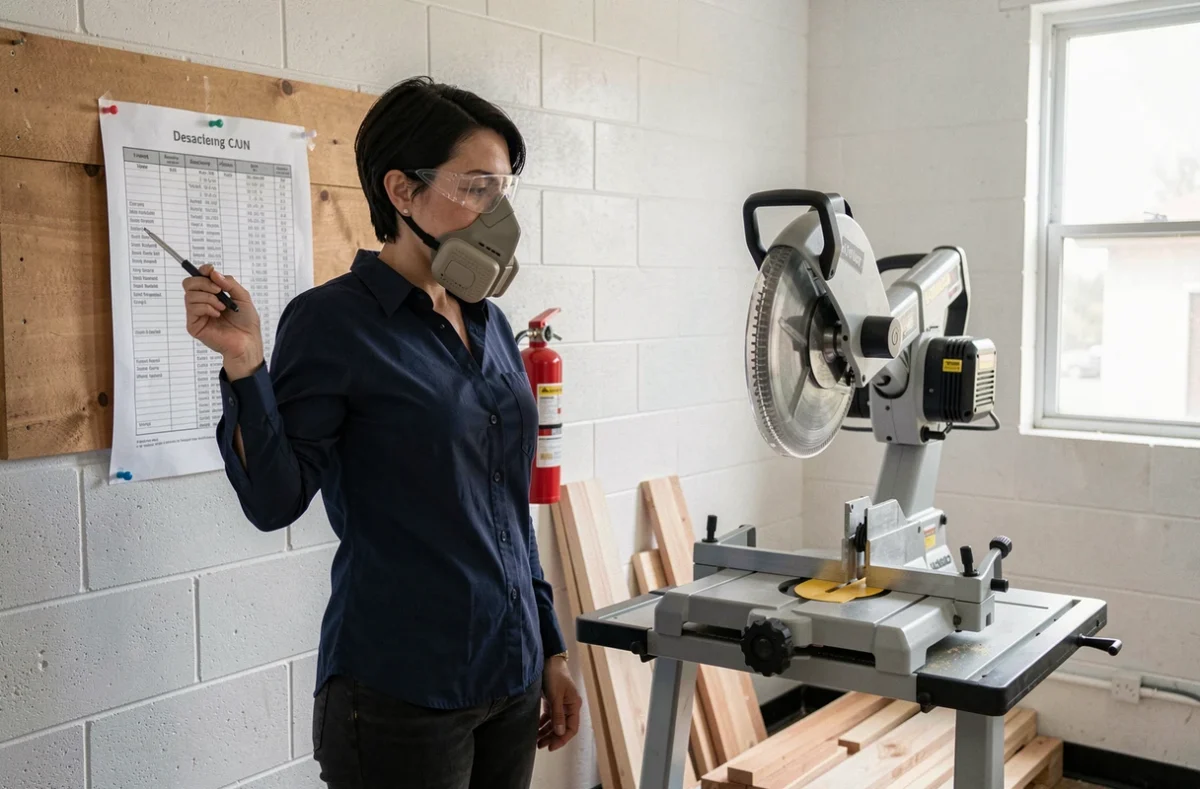
In a professional context, the radial miter saw falls under the category of work equipment subject to documentation tracking. According to the INRS, periodic checks must be organized based on risks, even without specific regulatory checks for this type of machine. The employer considers the conditions of use and the manufacturer’s recommendations.
In practical terms, this means recording in a safety register any detected anomalies (play in the pivot, wear of the guard, damaged cable) and noting the maintenance operations performed. This register is not just an administrative formality: it allows for tracking the machine’s history and justifying that preventive measures are in place.
Used machine: specific points of vigilance
When acquiring a used radial saw, the condition of the mobile guard deserves careful examination. The guard must meet the same criteria as when new: free of any friction, automatic return to the closed position, with no lateral play. A faulty guard on a used machine is grounds for immediate non-use.
- Check for the presence and legibility of the manufacturer’s nameplate.
- Inspect the condition of the power cable and plug.
- Manually test the mobile guard, with the machine unplugged, over several opening and closing cycles.
Feedback varies on the reliability of refurbished saws depending on the brands. When in doubt, having the machine inspected by a qualified professional remains the most reasonable precaution before any commissioning.
The radial miter saw remains a fearfully effective precision tool when its mechanical constraints are respected. The mobile guard, the condition of the blade, the holding of the piece, and the documentation tracking form a coherent set. Neglecting any one of these points undermines all the others.