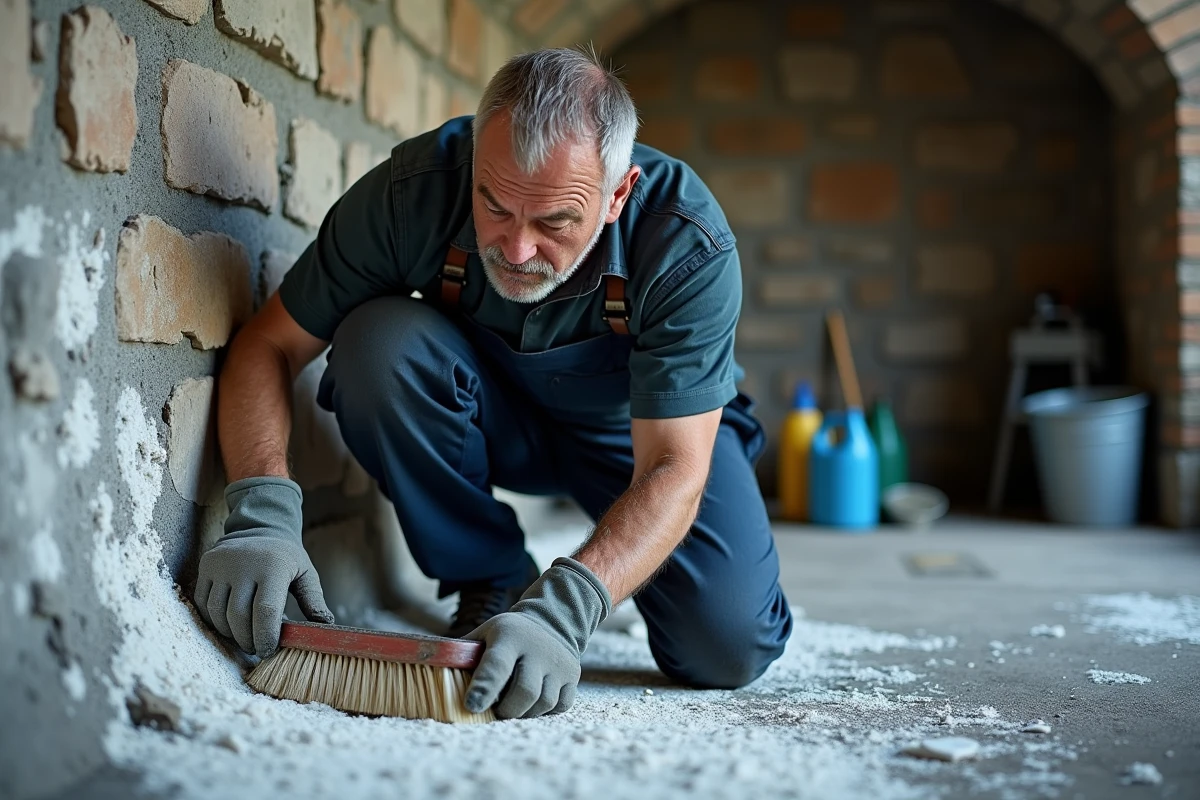
Whitish deposits that swell the joints, a coating that peels off in patches, a persistent earthy smell: when saltpeter settles in a cellar, it is often noticed too late. This mineral salt (potassium nitrate) results from the migration of water laden with salts through the masonry. Cleaning it off the surface does not solve anything if the source of moisture remains active.
Energy renovation and saltpeter in the cellar: an unanticipated side effect
We insulate the walls from the outside, replace the windows, treat the ground floor, and a few months later, saltpeter explodes in the cellar. This scenario is becoming more common in old solid masonry houses since the generalization of insulation work.
The mechanism is simple. Before the work, moisture from the ground rose by capillarity and evaporated everywhere, including through the upper parts of the walls. By reducing thermal losses, we alter the flow of water vapor. Moisture and salts concentrate in the buried parts, where no one has touched the ventilation.
The trap is that a moisture diagnosis is almost never included in a standard energy audit. We treat the envelope without asking where the water will migrate next. If you have insulated your house in recent years and your cellar shows signs of recent saltpeter, the coincidence is probably not one.
Additional information can be found on treating saltpeter in a cellar on Culture Bretagne, particularly to understand the mechanisms of capillary rise that feed these salt deposits.
Ground diagnosis before treating saltpeter: locating the water source
Before buying any anti-saltpeter product, we must answer one question: where is the water coming from? Treating the deposits without addressing the moisture is like repainting a wall that is taking in water.
The possible sources in a cellar are not all obvious. Here are the most common:
- Capillary rise, typical of old masonry without a capillary break. Water from the ground rises in the walls through the pores of the material and carries the salts with it.
- Lateral infiltrations due to hydrostatic pressure, when the ground around the cellar is poorly drained or when the water table rises during wet periods.
- Condensation, often underestimated: a poorly ventilated cellar where warm, humid air enters from above condenses on the cold walls, creating a permanent cycle of humidity.
- A defect in buried piping, rarer but sometimes the cause of localized issues on a single wall.
To differentiate between capillary rise and condensation, one can stick a square of clear plastic film on the damp wall and leave it for a few days. If moisture appears between the wall and the film, the water is coming from the wall. If it forms on the room side, it’s condensation.
Breathable mineral lining: an alternative to total waterproofing for old cellars
The classic response to saltpeter in cellars is resin lining. A waterproof coating is applied to the walls to block any water migration. On paper, it’s radical. In practice, rigid resins detach under hydrostatic pressure when structural humidity is high. Blisters, entire patches that peel off, and the problem returns worse than before.
For several years now, rehabilitation companies have increasingly favored breathable mineral lining systems. These coatings made from natural quick-setting cement or hydraulic binders are compatible with old stone or brick masonry.
Their principle differs from classic lining: instead of blocking water, they regulate its passage. The wall continues to “breathe,” the pressure behind the coating remains low, and the salts no longer crystallize on the surface. Results vary depending on configurations, but these systems show good results in semi-buried cellars where water pressure remains moderate.

This type of lining does not exempt one from addressing ventilation. A breathable coating in a cellar without air renewal will also eventually saturate.
Cleaning saltpeter and anti-saltpeter products: what really works
Once the source of moisture is identified and treated (or in the process of being treated), we can tackle the existing deposits. Order matters: clean before treating the substrate thoroughly.
Removing surface deposits
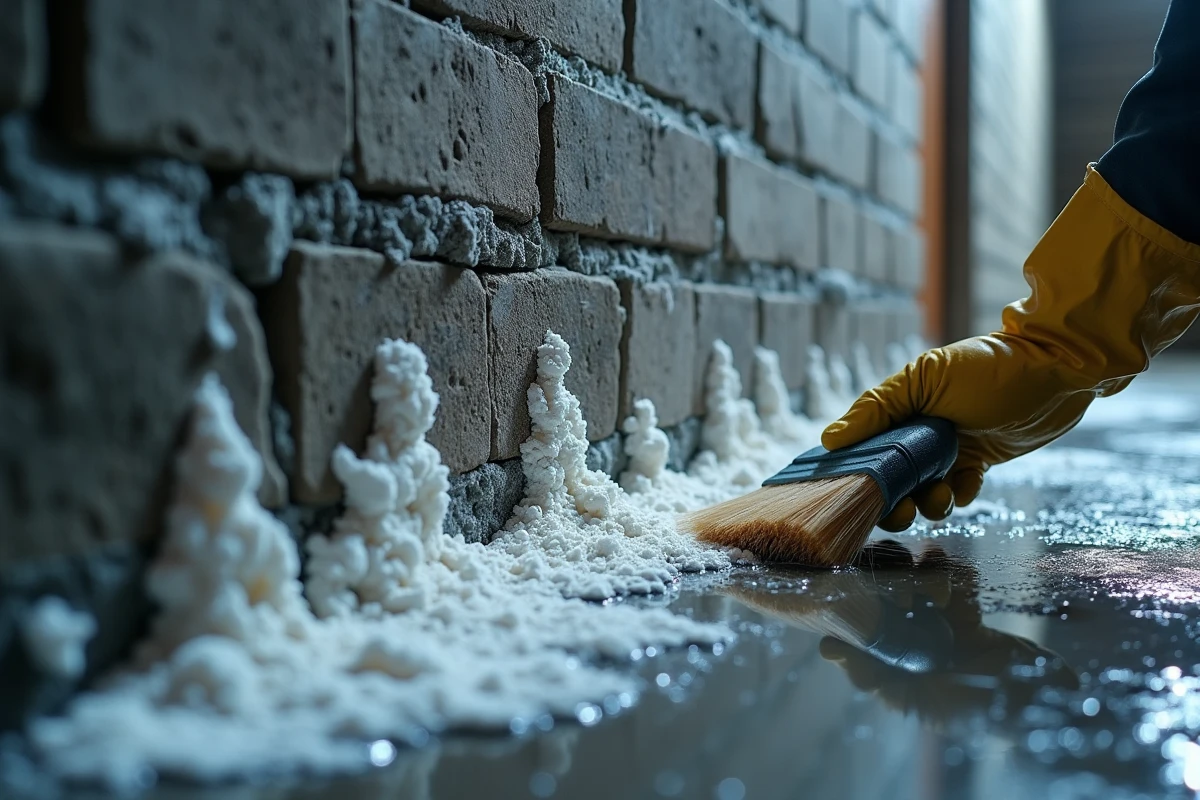
Brush the wall dry with a metal brush to remove as many crystals as possible. White vinegar or baking soda works for spot cleaning, but they do not prevent recurrence.
On heavily encrusted areas, rinsing with clear water followed by complete drying is preferable to acidic solutions that may damage some lime mortars.
Applying an anti-saltpeter product suitable for the substrate
Commercial anti-saltpeter products work in two ways: some neutralize the salts by making them insoluble, while others create a waterproof barrier in the material. The choice depends on the substrate.
- On old stone or brick masonry with lime joints, avoid film-forming waterproofers that block gas exchanges. A mineralizing treatment is more suitable.
- On concrete block or concrete, a mass water repellent or a lining provides more durable protection.
- On a wall already coated with cement, it is often necessary to remove the coating before treatment, as saltpeter forms at the interface between the old substrate and the waterproof coating.
Cellar ventilation and long-term prevention of saltpeter
Saltpeter returns as long as the conditions for its formation are present: water, salts in the material, and lack of controlled evaporation. Proper ventilation reduces relative humidity and slows the crystallization of salts on the surface.
In a semi-buried cellar, two opposing vents are often sufficient to create natural draft. If the configuration does not allow it, a mechanical ventilation system or an air extractor with a hygrostat maintains an acceptable humidity level without excessively drying the walls.
We also monitor the external surroundings: a sloping terrain towards the cellar, a gutter that pours at the foot of the wall, a blocked drain. These details contribute to lateral infiltrations much more than capillary rises in certain configurations.
Saltpeter in a cellar is not a fatality, but it cannot be treated with a single product. The combination of moisture diagnosis, treatment suitable for the substrate, and sustainable ventilation remains the only approach that lasts over time. When one has recently insulated their house, checking the cellar should be part of the post-work follow-up.